
By Jennifer Parker December 10, 2025
Centralized tutor scheduling vs. manual planning is one of the most important decisions a tutoring business or academic program makes. The way you schedule tutors, students, and sessions directly impacts profit margins, learning outcomes, staff satisfaction, and parent experience.
In recent years, tutor scheduling software has evolved from “nice-to-have” to a core infrastructure tool. Modern platforms combine calendars, payments, reporting, messaging, and even AI-based matching between tutors and students.
At the same time, many tutoring centers, schools, and independent tutors still rely on manual planning. They use spreadsheets, shared calendars, emails, and sticky notes to build schedules. Manual planning can feel flexible and low-cost, but it often hides serious time, error, and opportunity costs.
This guide breaks down centralized tutor scheduling vs. manual planning in depth. You’ll see how each approach affects efficiency, cost, data, and student experience, plus what the research and market trends say about the future of tutor scheduling.
By the end, you’ll have a clear framework to decide which option works best for your tutoring operation—now and in the years ahead.
Understanding Centralized Tutor Scheduling

Centralized tutor scheduling is a system-based approach where all booking, availability, session details, and changes are managed through one unified platform. Instead of dealing with separate spreadsheets, emails, and chat threads, tutors and coordinators work from a single scheduling hub.
In most cases, centralized tutor scheduling is powered by tutor management or scheduling software. These platforms act as a “command center” for your tutoring business.
They store tutor profiles, subject specializations, hourly rates, availability, and locations. They also store student preferences, goals, and time constraints, then coordinate matches and time slots between the two.
A centralized tutor scheduling system usually includes features such as online booking, automated confirmations and reminders, integrated payments, attendance tracking, and reporting dashboards.
Over time, the platform builds a complete record of every session, which becomes a valuable data asset for planning, staffing, and marketing.
In practice, centralized tutor scheduling reduces the number of “places” where scheduling conversations happen. Parents request sessions in one portal.
Tutors set their availability in the same system. Admins no longer hunt through dozens of messages to answer basic questions like “Who is free at 4 pm on Tuesdays for Algebra II?” The scheduling engine answers that directly using the data in the platform.
When people compare centralized tutor scheduling vs. manual planning, this consolidation is one of the biggest strengths of the centralized model. Everything lives in one place—making operations more predictable, auditable, and easy to scale.
Core Features of Centralized Tutor Scheduling Systems

Modern tutor scheduling software is much more than a digital calendar. To understand centralized tutor scheduling vs. manual planning, it helps to look closely at the core features these systems offer.
Most platforms start with online booking and availability management. Tutors set when they are available, define locations (online, in-home, center-based), and set rules for session length and lead time. Students or parents see only valid time slots based on those rules, which reduces back-and-forth and double-bookings.
On top of the basic calendar, centralized tutor scheduling tools typically provide automated reminders via email or SMS, plus self-service rescheduling and cancellation. These features directly reduce no-shows, which is one of the biggest pain points for tutoring businesses.
Most tutor management platforms also integrate payments and invoicing. Families can pay when they book or be billed automatically after sessions. The system tracks what has been paid, what’s overdue, and which sessions are pre-paid—for example, when parents buy a package of ten lessons.
Other common features include:
- Student and tutor profiles with subjects, levels, and preferences
- Session notes and progress tracking
- Group class scheduling and capacity limits
- Multi-location support for centers and franchises
- Reporting on utilization, revenue, and tutor performance
As AI and automation spread across scheduling software, more systems add smart matching, suggested times based on historical patterns, and optimization features that fill gaps in tutors’ calendars automatically.
Compared to manual planning, centralized tutor scheduling brings these capabilities together in one place, which is why it increasingly becomes the default choice for growing tutoring operations.
How Centralized Tutor Scheduling Works in Different Tutoring Models
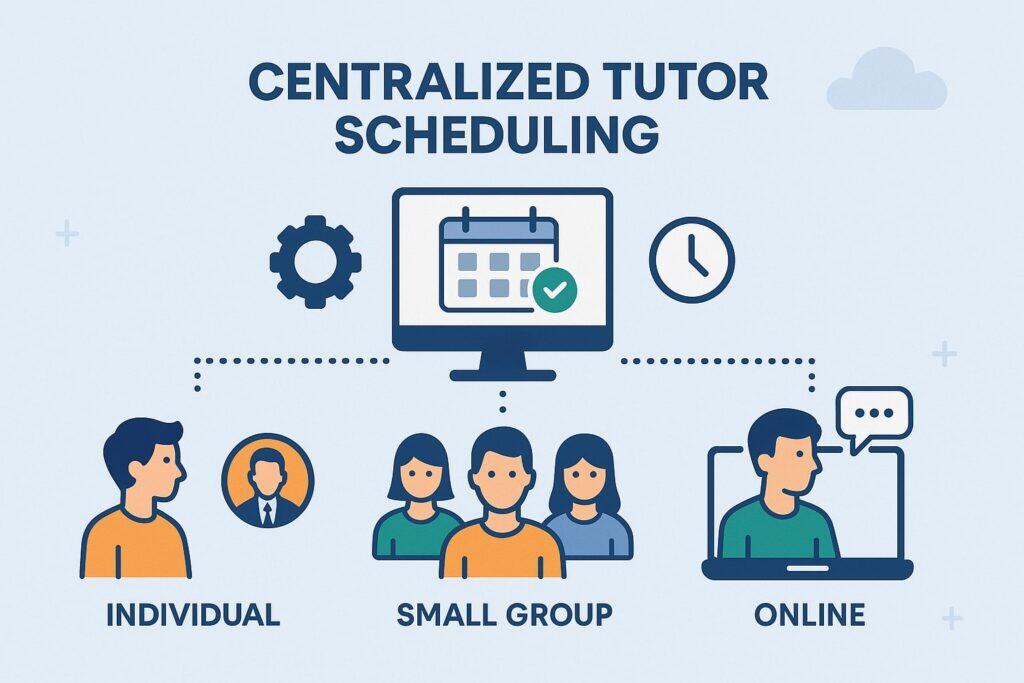
Centralized tutor scheduling looks slightly different depending on your model, but the core concept stays the same: one system, one source of truth.
For independent tutors, centralized scheduling usually means using an appointment tool or lightweight tutor management platform. Students see a booking page linked from the tutor’s website or social profile. They pick a time, choose online or in-person, and pay if required. The tutor’s calendar syncs automatically, and reminders go out without any extra work.
In small tutoring centers, centralized tutor scheduling becomes the backbone of daily operations. Admin staff coordinate dozens or hundreds of weekly sessions across multiple tutors, subjects, and age groups.
The scheduling system ensures that tutors are not double-booked, rooms are not overused, and each student gets placed with the right person at the right time. Multi-tutor platforms handle recurring schedules, group classes, and multi-location support, which are difficult to manage manually at scale.
For school districts and higher education programs that offer supplemental tutoring, centralized tutor scheduling often integrates with existing student information systems and learning management systems.
Schedules must align with bell times, course timetables, and classroom availability. AI-enhanced scheduling engines can automatically assign tutors to groups of students based on need, subject, and time constraints, significantly reducing the workload on coordinators.
Across all these models, centralized scheduling reduces the number of decisions humans have to make manually. Instead of starting from a blank spreadsheet each semester, staff define rules and constraints, then use the platform to generate or maintain the schedule.
When comparing centralized tutor scheduling vs. manual planning, this automation is one of the most powerful advantages.
What Is Manual Planning for Tutor Scheduling?
Manual planning refers to any approach where people create and update the tutoring schedule by hand. This can mean using paper calendars, shared spreadsheets, email threads, messaging apps, or basic non-specialized calendar tools. No single system “owns” the schedule; instead, the schedule exists as a patchwork of documents and communications.
Many tutoring businesses and programs start with manual planning. At small volume, it can feel fast and personal. You know each student and tutor by name, and you remember who prefers which time slot. However, as soon as the number of sessions grows, manual planning begins to break down under the complexity.
Manual planning also relies heavily on the memory and availability of specific individuals—often one admin or manager. If that person takes time off or leaves, the scheduling process can become chaotic.
It’s common to see last-minute changes missed, tutors double-booked, and families confused about which tutor they are seeing and when.
When evaluating centralized tutor scheduling vs. manual planning, it’s important to understand that manual planning is not inherently “bad.” It can still be the right choice for very small operations or short-term programs. But the risks and hidden costs grow quickly as the organization scales.
Common Manual Scheduling Methods (Spreadsheets, Paper, and Email)
Manual tutor scheduling often emerges organically. A tutor or coordinator picks the tools they already know and stitches them together.
One of the most common methods is spreadsheet-based scheduling. Admins build a grid with days, times, tutor names, and student names. They color-code subjects, add notes in cells, and use comments to track vacation or test prep periods.
Spreadsheets are flexible and familiar, but they lack built-in validation. A simple copy-paste can create overlapping sessions or mismatched assignments without anyone noticing.
Another traditional method is paper timetables. Some centers keep a master schedule printed and pinned to a wall or kept in a binder at the front desk. Tutors and students call or walk in to request changes, which staff scribble in by hand.
While this can feel very personal, it becomes fragile when staff are busy. Changes are easy to miss, and handwritten notes can be misread.
Email and messaging-based planning is also extremely common. Parents email or text to request sessions. Tutors email their availability. The coordinator replies with proposed times. After several back-and-forth messages, a slot is agreed.
But if one person forgets to update their personal calendar or a message gets buried, the entire chain breaks down.
In practice, many manual planning environments use all three at once: a spreadsheet for the “official” schedule, a paper copy at the front desk, and email or messages for day-to-day changes.
This patchwork makes it very hard to answer basic questions like “What does the schedule actually look like next Tuesday?”—especially when last-minute changes are frequent.
Risks and Limitations of Manual Planning
Manual planning carries several structural risks that become severe as a tutoring operation grows. When you compare centralized tutor scheduling vs. manual planning, these risks are often the tipping point that pushes organizations toward software.
First, manual planning is time-consuming. Research on manual timetabling in education shows that building schedules can require a team of five to eight people, working through many iterations to resolve conflicts.
In a tutoring context, this translates into staff hours that could be spent on coaching tutors, supporting families, or marketing your services instead of manipulating spreadsheets.
Second, manual systems are error-prone. Double-bookings, tutor conflicts, overfilled rooms, and forgotten schedule changes are common. Traditional scheduling methods depend heavily on human attention and memory, which are limited—especially during busy seasons such as back-to-school or exam periods.
Third, manual planning lacks real-time visibility. If the master schedule lives in a spreadsheet on a single computer or in a binder, it’s hard for tutors and families to check details without contacting staff. This increases call volume and email traffic, especially when weather events or test dates trigger many same-week changes.
Fourth, manual methods do not generate rich data. You may have some basic counts of hours delivered per tutor, but you typically lack deeper analytics like utilization rates, subject-specific demand patterns, or correlations between session frequency and academic outcomes. That data is essential for long-term planning, pricing, and staffing decisions.
Finally, manual planning can create equity issues. Families who are more assertive or more comfortable with constant email follow-ups may get better time slots. Centralized systems can help enforce fair policies and priorities—for example, ensuring students with the highest academic need are offered tutoring during optimal times.
Centralized Tutor Scheduling vs. Manual Planning: Key Differences
When you evaluate centralized tutor scheduling vs. manual planning, the most important differences show up in four areas: efficiency, accuracy, data, and experience.
Centralized tutor scheduling dramatically reduces the administrative load required to manage a schedule. Software automates repetitive tasks like sending confirmations, handling reschedules, syncing calendars, and issuing reminders.
Manual planning, in contrast, requires constant hands-on work every time someone wants to book, change, or cancel a session.
Accuracy is the second major difference. A centralized tutor scheduling platform applies rules consistently. It won’t let you double-book a tutor or assign them to two locations at the same time. Manual planning relies on humans to notice conflicts, which becomes much harder as the schedule grows in size and complexity.
Third, centralized systems create structured data. You can see which tutors are under- or over-utilized, which time slots are in highest demand, which subjects drive the most revenue, and which students are at risk of disengaging. Manual schedules rarely provide this level of insight without a lot of extra work.
Finally, centralized tutor scheduling improves the experience for tutors, students, and families. With online portals and self-service tools, people can see their schedules, request changes, and receive reminders without waiting on an admin reply.
Manual planning often leads to delays, miscommunication, and frustration—especially when staff are dealing with many competing priorities.
These differences are why centralized tutor scheduling vs. manual planning is usually not a close contest once an organization reaches a certain size or complexity.
Efficiency and Time Management
Efficiency is the area where centralized tutor scheduling typically outperforms manual planning most dramatically.
With centralized scheduling, admins set up rules once—such as tutor availability windows, allowed locations, subject constraints, and lead-time requirements. After that, the system enforces those rules automatically.
Booking a session doesn’t require a long email thread; it takes a few clicks. Automated reminders go out without anyone touching a keyboard.
Manual planning, on the other hand, consumes admin time at every step. A parent emails, someone checks a spreadsheet, asks the tutor, updates the sheet, confirms with the parent, and maybe prints a new copy of the schedule.
When a reschedule request arrives, the whole process repeats. During peak periods, staff can spend most of their day just keeping the schedule from falling apart.
Research on scheduling and timetabling in education shows that manual approaches often require multiple rounds of revisions and meetings to resolve conflicts. Automated systems generate workable schedules in a fraction of the time.
From an efficiency standpoint, centralized tutor scheduling vs. manual planning becomes even more lopsided as you grow. The marginal cost of adding one more session in a centralized system is tiny, because the platform handles most of the work. In manual environments, each added session creates more complexity and potential for errors.
In the near future, AI-powered scheduling will likely push this gap even further. Intelligent systems can auto-fill tutor calendars based on historical demand patterns, proactively suggest optimized times for popular subjects, and balance schedules to avoid burnout—all without adding more admin hours.
Accuracy, Conflicts, and No-Shows
Centralized tutor scheduling significantly reduces scheduling errors and missed sessions compared to manual planning.
Digital scheduling engines are designed to enforce constraints and avoid conflicts. They check every booking against tutor availability, subject qualifications, location capacity, and even travel time if in-person sessions are involved. When a tutor updates their availability, the system instantly reflects that change across all booking options.
Manual planning depends on humans to notice conflicts. When schedules live in spreadsheets, paper calendars, and emails, there is no automatic validation.
A coordinator might forget that a tutor is already assigned to a group class, or misread a handwritten time. These mistakes result in double-bookings, last-minute cancellations, or tutors rushing between overlapping commitments.
No-shows are another critical area. Centralized tutor scheduling platforms typically include automated reminders via email, SMS, or push notifications.
These reminders reduce missed sessions by keeping the appointment top-of-mind, especially for busy families. Some platforms also send follow-up messages if a student does not join an online session on time, allowing quick intervention.
Manual planning often lacks systematic reminder workflows. Staff may call or email for high-stakes sessions, but they can’t realistically do this every time, especially at scale. As a result, no-shows remain high, which hurts revenue and learning consistency.
Looking ahead, more centralized scheduling platforms are adding real-time alerts and AI-based predictions—flagging which sessions are most likely to become no-shows based on past behavior and offering incentives or extra reminders to prevent them. Manual planning can’t easily replicate this kind of predictive accuracy.
Data, Reporting, and Decision-Making
One of the biggest differences between centralized tutor scheduling vs. manual planning is the quality of data you get for decisions.
Centralized systems record every session with consistent fields: tutor, student, subject, level, time, duration, price, status, and outcomes. Over time, this becomes a rich dataset for analyzing demand patterns, pricing strategy, tutor performance, and student engagement.
Many tutor management platforms include dashboards for utilization, revenue trends, and attendance, making it easy to see what’s working and what needs adjustment.
In a manual environment, much of this information is scattered. Some details live in spreadsheets, some in email threads, some in payment systems, and some only in staff memories.
Pulling even basic reports—such as total hours delivered per tutor by subject—can require hours of manual counting and cross-checking. As a result, strategic planning often happens based on gut feeling instead of data.
Data-driven decisions are increasingly crucial in tutoring due to strong growth and competition in the tutoring software and online private tutoring markets.
Forecasts show that tutoring and teacher scheduling software markets are growing at robust compound annual rates through 2030 and beyond, driven by increased demand for personalized learning and online services.
Centralized tutor scheduling positions your organization to use that data advantage. You can predict busy seasons, adjust staffing proactively, and test new offerings using real metrics. Manual planning keeps you reactive—you see issues only after they’ve already impacted students and revenue.
Student and Family Experience
Parents and students increasingly expect a modern, seamless experience when they work with education providers. Centralized tutor scheduling helps you deliver that.
With a centralized system, families can self-book sessions online, see real-time availability, receive confirmations and reminders, and access their schedule from any device. They don’t need to call during business hours or wait for an email reply. If they need to reschedule, they can often do it in a few clicks within policy rules you define.
Manual planning makes families dependent on staff. They may have to leave voicemails, send multiple emails, or wait for a coordinator to update a spreadsheet. If the business is busy, delays can stretch out, leading to frustration and confusion. Small mistakes—like forgetting to forward an updated schedule—can create a perception of disorganization.
Centralized tutor scheduling also improves communication. Many platforms offer built-in messaging, so tutors can share session notes, homework, and progress updates through the same system.
Parents see a complete picture of their child’s tutoring journey in one place. Manual environments often scatter these messages across different channels, making it harder for families to stay informed.
In the future, centralized platforms are likely to add even more personalization features: recommended session frequency, dynamic schedule suggestions based on exam dates, and tailored nudges to help students stay on track. Manual planning tends to prioritize “keeping up” over delivering this level of tailored experience.
Cost-Benefit Analysis for Tutoring Businesses
When comparing centralized tutor scheduling vs. manual planning, cost is often the first concern. Manual methods seem “free,” while software has an obvious price tag. But a deeper look reveals that manual planning has significant hidden costs—and that centralized scheduling can deliver a strong return on investment.
Centralized tutor scheduling platforms typically charge monthly or annual subscriptions, sometimes with per-tutor, per-seat, or per-session fees. At first glance, this can feel like a new expense category.
However, those costs must be weighed against staff time saved, reduced no-shows, better utilization of tutors, and improved revenue collection.
Manual planning consumes paid administrative hours. As volume grows, you may need more staff just to manage the schedule. There are also costs associated with errors—mis-booked sessions, lost opportunities, double-bookings that lead to refunds, and no-shows that were never reminded.
A thoughtful cost-benefit analysis compares the total cost of ownership for software (subscription, onboarding, occasional training) with the value of time saved and revenue protected.
In many cases, the math shows that centralized tutor scheduling pays for itself quickly, especially for organizations with multiple tutors.
Direct and Hidden Costs of Manual Tutor Scheduling
Manual planning seems inexpensive because you’re not paying for a dedicated platform. But that doesn’t mean it’s cost-free.
Direct costs include staff time spent on scheduling tasks. If an administrator spends two to three hours per day answering scheduling emails, updating spreadsheets, and fixing errors, that time has a real hourly value. Over a month or a year, that adds up to a significant expense.
Hidden costs can be even larger. When comparing centralized tutor scheduling vs. manual planning, consider these:
- Lost revenue from no-shows: Without automated reminders, missed sessions are more common. Every no-show represents both lost revenue and a lost learning opportunity.
- Double-bookings and conflicts: Manual errors can force you to offer refunds, discounts, or free make-up sessions, directly impacting margins.
- Underutilized tutors: When there’s no clear view of which tutors have gaps, you may miss chances to fill their schedules—lowering revenue per tutor.
- Staff burnout and turnover: Constant crisis management and schedule juggling can exhaust admins and coordinators, leading to turnover and additional hiring and training costs.
Manual planning also limits your capacity to grow. At some point, you may simply “hit a wall” where the current staff cannot manage any more sessions without more headcount. That ceiling becomes a hidden cap on your revenue potential.
Software Subscription Costs vs. Productivity Gains
Centralized tutor scheduling software has clear subscription costs, but these must be evaluated alongside measurable productivity gains.
Most tutor scheduling platforms offer tiered pricing. Small operations might pay a modest monthly fee for a solution that handles online bookings, reminders, and basic reporting. Larger centers use higher-tier plans that support multiple locations, groups, and advanced analytics.
Productivity gains show up in multiple ways:
- Admin time saved: If a platform cuts scheduling time in half, staff can handle more students or focus on value-adding tasks like customer service and marketing.
- Reduced no-shows: Automated reminders and easier rescheduling typically reduce missed sessions, directly increasing billable hours.
- Faster cash flow: Integrated payments mean fewer unpaid sessions and less time chasing invoices.
- Better tutor utilization: Data on tutor availability and demand helps you match supply and demand more accurately, increasing revenue per tutor.
In many small and mid-size operations, the subscription cost of centralized tutor scheduling is offset by the recovered admin time alone. When you add the benefits of higher revenue and fewer errors, the ROI becomes even more compelling.
Looking ahead, as AI scheduling and automation become standard features, the productivity gap between centralized tutor scheduling vs. manual planning will likely widen further. The organizations that invest early will have a structural efficiency advantage over those that remain manual.
ROI Scenarios for Small, Medium, and Large Tutoring Operations
The return on investment for centralized tutor scheduling vs. manual planning varies by size and complexity, but the trend is consistent: the larger and more complex the operation, the stronger the case for centralized scheduling.
Small, independent tutors
A solo tutor might handle a modest number of sessions per week. Manual methods can work, but they still create friction and no-shows. In this scenario, a low-cost scheduling tool often pays off by cutting no-shows and reducing unpaid time spent coordinating. Even a few recovered sessions per month can cover subscription fees.
Small to medium centers
Once you have several tutors and dozens of weekly sessions, manual planning becomes a serious bottleneck. One administrator might spend a large portion of their time on scheduling alone.
Centralized scheduling can reclaim many hours per week, allowing the center to support more students without hiring additional staff. The ROI here often shows up in both productivity and revenue expansion.
Large centers, school partnerships, and multi-location operations
At this level, manual planning is rarely sustainable. The risk of errors and the volume of changes make spreadsheets and paper systems extremely fragile. Centralized tutor scheduling with multi-location and enterprise features helps manage complex constraints, integrates with other systems, and provides data for strategic decisions.
Across all sizes, the growing tutoring software market suggests that more organizations are making this switch, attracted by the long-term ROI of centralized scheduling.
Operational Impact in Different Tutoring Environments
Centralized tutor scheduling vs. manual planning doesn’t play out the same way for every type of tutoring environment. The right strategy depends on how you deliver services and who you serve.
Independent Tutors and Micro-Businesses
Independent tutors often start with manual scheduling because it feels quick and personal. Text messages, emails, and a simple calendar can be enough when you only work with a handful of students.
However, even solo tutors face challenges that centralized tutor scheduling can solve:
- Students forget sessions without reminders.
- Reschedules and cancellations arrive at all hours, disrupting your day.
- Collecting payments after each session becomes tedious.
A lightweight centralized tutor scheduling tool can help independent tutors build a more professional brand. Students and parents see a booking link, select times that fit your availability, and pay in advance.
Automated reminders improve attendance, and you get a clear record of all sessions for tax and planning purposes.
In the competition between centralized tutor scheduling vs. manual planning at this level, manual planning can still work—but it often limits growth. As soon as a tutor wants to increase hours, add small groups, or hire a second tutor, centralized scheduling makes that transition smoother.
Over the next few years, more independent tutors are expected to adopt AI-enhanced scheduling tools that recommend ideal times based on student time zones, exam calendars, and historical attendance patterns. Manual methods will struggle to match that level of optimization.
Learning Centers and After-School Programs
For learning centers and after-school programs, the choice between centralized tutor scheduling vs. manual planning is especially consequential. These environments juggle many students, varied subjects, and a mix of one-on-one and group sessions.
Centralized scheduling helps centers:
- Prevent conflicts in tutor assignments and classroom use
- Manage different service types (drop-in, recurring, test prep intensives)
- Track attendance and outcomes for reporting and funding
- Scale across multiple rooms and locations
Manual planning in this context often leads to constant schedule emergencies. Staff spend significant time adjusting paper schedules and spreadsheets as parents change pickup times or students join new programs. Rooms get overbooked, or tutors end up with awkward gaps in their day.
Centralized tutor scheduling platforms allow after-school programs to centralize policies and automate consistent practices—such as how far in advance families can book, cutoffs for cancellations, and priority rules for students with higher academic needs.
As more centers adopt digital tools, families will increasingly expect online booking and real-time updates. Centers that stay on manual systems may appear outdated, even if their instruction quality is high.
School Districts, Higher Education, and Nonprofit Programs
In school districts, colleges, and nonprofit tutoring programs, the scheduling problem becomes even more complex. There are bell schedules, course timetables, facility constraints, and specific requirements for high-impact tutoring blocks.
Centralized tutor scheduling supports these environments by integrating with student information systems, ensuring that tutoring sessions align with classes, transportation schedules, and special services.
It also helps ensure compliance with funding requirements and documentation standards, which often require detailed tracking of hours, student groups, and outcomes.
Manual planning at this scale is extremely labor-intensive. Coordinators may spend weeks building initial schedules and then months maintaining them.
As research on manual vs. automated timetabling shows, manual methods require multiple experts to perform iterative adjustments to handle constraints—whereas automated systems produce efficient schedules much faster.
Nonprofit programs that rely on volunteers or part-time tutors also benefit from centralized scheduling. Volunteers can set their availability, sign up for specific sessions, and receive automated reminders. Program staff can monitor attendance and adjust schedules to maximize impact on priority students.
Looking forward, centralized systems for institutional tutoring are likely to integrate even more deeply with district-wide planning tools and AI-driven resource optimization. Manual planning will increasingly be reserved for very small pilots or special cases, not for ongoing operations.
Implementing Centralized Tutor Scheduling: Best Practices
Switching from manual planning to centralized tutor scheduling is a strategic change, not just a software purchase. The way you implement the platform determines how much value you get from it.
Choosing the Right Platform and Features
Before selecting a solution, clarify your needs using concrete questions:
- How many tutors and students do you schedule each week?
- Do you primarily offer one-on-one sessions, groups, or a mix?
- Do you need online, in-person, or hybrid scheduling?
- What existing tools (LMS, CRM, payment systems) must it connect with?
Then, compare tutor scheduling platforms based on core features:
- Online booking and availability management
- Automated reminders and follow-ups
- Integrated payments and invoicing
- Support for multiple locations and programs
- Reporting and analytics capabilities
Some platforms specialize in independent tutors, while others focus on agencies, learning centers, or enterprise education. Review current comparisons of top tutor scheduling software to understand which tools are best for your size and model.
As you evaluate centralized tutor scheduling vs. manual planning, remember that the “cheapest” platform isn’t always the best. Consider ease of use, your team’s learning curve, support quality, and the potential for future features like AI-based scheduling.
Change Management and Staff Training
Introducing centralized tutor scheduling is also a change management project. If staff and tutors are used to manual planning, they may be hesitant to switch—even if the new system clearly reduces workload.
Start by explaining why you’re moving away from manual planning. Highlight pain points such as double-bookings, no-shows, or long hours spent adjusting schedules. Then show how centralized tutor scheduling addresses those issues. Involve key team members in platform selection so they feel ownership of the decision.
Provide structured training sessions for admins, tutors, and, where appropriate, parents or students. Use live demos, short how-to videos, and clear written guides. Encourage people to practice booking test sessions and using the system in a low-stakes environment before it goes live.
During the first few weeks, allow time for both systems to overlap. Keep the old manual schedule in place for reference, but run all new bookings through the centralized platform. This parallel period helps catch data entry errors and build confidence.
In the long term, success depends on consistency. Make the centralized tutor scheduling system the single source of truth. Discourage scheduling by email or informal chat once the platform is established, and update your policies and contracts to reflect this.
Integrations with LMS, CRM, and Payment Systems
One of the biggest advantages of modern centralized tutor scheduling is integration with other tools you already use.
For online tutoring, integration with a learning management system or virtual classroom tool can automatically create meeting links, record attendance, and link session notes to assignments. This reduces double data entry and helps tutors see academic context while planning sessions.
Integration with a CRM helps you track leads from initial inquiry through enrollment and long-term retention. Scheduling data can trigger automated marketing campaigns—for example, sending a reminder when a student hasn’t booked a session in several weeks.
Payment integration is crucial for cash flow. When your scheduling platform connects directly to payment processors, you can charge at booking, handle subscriptions or packages, and reconcile billing with actual attendance.
This reduces time spent chasing unpaid invoices and helps ensure that every scheduled session is either paid or clearly marked for follow-up.
As you compare centralized tutor scheduling vs. manual planning, factor in these integration benefits. Manual systems rarely tie together your learning, CRM, and payment data seamlessly. Centralized systems increasingly offer API access and pre-built connectors, making it easier to build a unified tech stack.
Future of Tutor Scheduling: AI, Automation, and Personalization
The future of tutor scheduling is being shaped by AI, automation, and data-driven personalization. This is where centralized tutor scheduling vs. manual planning becomes an even sharper contrast.
AI-Driven Matching and Dynamic Scheduling
AI is already being used in education scheduling to automate complex tasks such as course timetabling and staff allocation. In the tutoring world, AI can match students with the best tutor based on subject, learning style, availability, and historical outcomes.
AI-based centralized tutor scheduling can also generate dynamic schedules. Instead of static weekly slots, the system can adjust session times based on exam dates, academic risk signals, and student attendance patterns.
For example, a student who consistently misses early morning sessions may be automatically nudged to book afternoon times.
Manual planning cannot realistically achieve this level of fine-grained optimization. Even with dedicated staff, tracking all these variables for dozens or hundreds of students is not feasible.
As AI scheduling tools continue to improve, we can expect features like:
- Automated schedule proposals for new students based on similar learners
- Real-time balancing of tutor workloads to avoid burnout
- Intelligent waitlist management that fills cancellations in minutes
These capabilities further tilt the scales in favor of centralized tutor scheduling vs. manual planning for any organization seeking long-term competitiveness.
Predictive Analytics and Capacity Planning
Beyond day-to-day scheduling, centralized systems are evolving into strategic planning tools. Predictive analytics use historical data to forecast demand for specific subjects, grade levels, and time slots. This helps you make smarter decisions about hiring, training, and marketing.
For example, analytics might reveal that demand for calculus tutoring spikes each fall, while reading support peaks in early spring. With centralized scheduling data, you can staff up proactively, cross-train tutors, or create targeted seasonal programs.
Predictive models can also help with capacity planning. They can estimate how many tutoring hours you’ll need to deliver per week to maintain certain outcome goals or revenue targets. If you plan to expand to new neighborhoods or launch additional subjects, centralized scheduling data gives you a realistic picture of what that will require.
Manual planning cannot easily produce this level of insight. It’s difficult to run forecasts from scattered spreadsheets and paper schedules. As a result, decisions often rely on intuition instead of empirical trends.
In the coming years, predictive analytics will likely integrate with external data sources such as local school calendars, exam schedules, and demographic trends. This will make centralized tutor scheduling an even more powerful strategic asset.
Accessibility, Equity, and Regulatory Trends
Tutor scheduling is not just an operational problem; it touches issues of accessibility and equity. Centralized systems can support fairer access to tutoring by enforcing transparent priorities—for example, ensuring students with the greatest academic need receive first access to high-impact tutoring slots.
Centralized platforms can also make it easier to comply with emerging regulations and funding requirements. Many publicly supported tutoring programs require detailed reporting on session frequency, duration, and student participation. Automated tracking and reporting lighten the administrative burden compared to manual logs.
Accessibility features are also improving. Centralized tutor scheduling tools can offer multilingual interfaces, screen-reader compatibility, and mobile apps that support families with limited desktop access.
Manual systems—especially paper-based ones—often exclude or disadvantage families who cannot easily call during working hours or manage complex email threads.
As policymakers continue to emphasize high-impact tutoring and learning recovery, the expectations for documentation and equity will grow. Centralized tutor scheduling positions organizations to meet these expectations with less friction than manual planning.
How to Decide What Works Best for Your Tutoring Operation
Choosing between centralized tutor scheduling vs. manual planning is ultimately about fit, not just technology. The right approach depends on your size, complexity, and growth plans.
Decision Checklist and Readiness Assessment
Use this checklist to evaluate whether it’s time to adopt centralized tutor scheduling:
- Volume and complexity:
- Do you schedule more than a handful of sessions each week?
- Do you have multiple tutors, locations, or group classes?
- Do you schedule more than a handful of sessions each week?
- Error rate and stress level:
- Are double-bookings, missing tutors, or no-shows frequent issues?
- Do staff feel overwhelmed by schedule changes?
- Are double-bookings, missing tutors, or no-shows frequent issues?
- Data and reporting needs:
- Do you need reports for funding, stakeholders, or growth planning?
- Are you guessing about demand patterns because data is hard to gather?
- Do you need reports for funding, stakeholders, or growth planning?
- Family and tutor expectations:
- Are families asking for online booking or clearer communication?
- Do tutors want a simpler way to manage availability and see schedules?
- Are families asking for online booking or clearer communication?
- Growth goals:
- Do you plan to add subjects, locations, or partnerships?
- Are you constrained by how much scheduling your team can handle now?
- Do you plan to add subjects, locations, or partnerships?
If you answered “yes” to several of these questions, centralized tutor scheduling vs. manual planning is no longer a theoretical debate. You are likely ready for a centralized platform, even if you start with a small plan and scale up.
Consider piloting a system with a subset of tutors or programs. Measure impacts on no-shows, admin time, and family satisfaction. Use those numbers to build an internal business case for expanding the system.
Hybrid Approaches That Combine Manual and Centralized Methods
In some cases, a hybrid approach can offer a practical bridge between manual planning and fully centralized scheduling.
For example:
- You might use centralized tutor scheduling for all new students, while maintaining existing long-term clients on manual schedules during a transition period.
- Group programs or high-impact tutoring blocks might be centrally scheduled, while occasional ad hoc sessions remain manual.
- Admins might still use spreadsheets for certain internal planning tasks, but the official schedule seen by families and tutors lives in the centralized platform.
Hybrid approaches can reduce resistance by allowing staff to keep some familiar tools while shifting the core scheduling function to software. Over time, as confidence grows, you can phase out manual components that no longer add value.
When designing a hybrid approach, clearly define which system is the “source of truth” for each type of session. Avoid duplicating the same schedule in both manual and centralized tools, which can lead to confusion and errors.
Ultimately, even hybrid strategies tend to move in the direction of more centralization. As you experience the benefits of centralized tutor scheduling vs. manual planning—especially reduced errors and better data—the incentive to simplify and standardize grows.
FAQs
Q1. Is centralized tutor scheduling only for large tutoring companies?
Answer: No. While large tutoring companies and institutional programs benefit significantly from centralized tutor scheduling, many independent tutors and micro-businesses use scheduling software successfully.
For solo tutors, centralized systems can:
- Reduce no-shows with automated reminders
- Simplify payments and invoicing
- Provide a professional booking experience for families
If you run even a modest number of weekly sessions, the time saved and revenue protected can easily offset the software subscription. As you grow, centralized tutor scheduling scales with you, whereas manual planning becomes more fragile.
Q2. What if my tutors or staff are not tech-savvy?
Answer: Most modern scheduling platforms are built with ease of use in mind. They use familiar calendar views, simple forms, and mobile-friendly interfaces. Short training sessions and step-by-step guides can help even non-technical staff become comfortable quickly.
It also helps to roll out the system gradually, starting with core features like viewing schedules and marking attendance before introducing advanced tools. Many vendors offer onboarding support, training materials, and customer success teams to help with adoption.
Compared to managing complex manual spreadsheets and email chains, many staff eventually find centralized tutor scheduling simpler and less stressful.
Q3. Is centralized tutor scheduling secure and compliant?
Answer: Reputable tutor scheduling and education software vendors implement robust security and privacy practices, including encrypted connections, role-based access controls, and regular security updates. They also typically provide tools to help you comply with local privacy regulations and school district requirements.
When evaluating vendors, ask about their security certifications, data storage locations, and privacy policies. Check whether they offer features like audit logs, permission controls, and data export so you maintain control over your records.
While no system can eliminate risk entirely, centralized platforms often provide better security than ad hoc manual methods that scatter sensitive information across emails, local spreadsheets, and printed schedules.
Q4. How long does it take to switch from manual planning to centralized scheduling?
Answer: Transition time depends on the complexity of your current schedule and the size of your team. For small operations, it might take just a few days to set up the platform, import student and tutor data, and begin booking sessions. Larger centers or institutional programs may need several weeks to design workflows, integrate with existing systems, and train staff.
A phased rollout—starting with one program, location, or group of tutors—can make the process smoother. Most organizations find that the early effort is quickly repaid in time saved and fewer scheduling crises.
Q5. Will centralized tutor scheduling reduce the personal touch with families?
Answer: Centralized scheduling doesn’t have to eliminate personal relationships. Instead, it can free staff from repetitive administrative tasks so they can spend more time on meaningful conversations with families.
You can still offer personalized recommendations, check-ins, and support. The difference is that booking, reminders, and basic logistics happen automatically. Many families actually experience centralized tutor scheduling as more respectful of their time, since they can self-book and see their schedule clearly.
Some platforms also allow you to customize messages, add personal notes, and share progress updates, enhancing the personal touch instead of replacing it.
Conclusion
When you weigh centralized tutor scheduling vs. manual planning, the evidence is clear. For most modern tutoring operations—especially those planning to grow—centralized scheduling delivers superior efficiency, accuracy, data, and user experience.
Manual planning can still be workable for very small, low-volume situations. But as soon as you introduce multiple tutors, multiple programs, or any meaningful scale, manual systems become a bottleneck. They introduce errors, consume staff time, and limit your ability to make data-driven decisions.
Centralized tutor scheduling, powered by modern software, allows you to:
- Automate repetitive tasks like reminders, reschedules, and payments
- Prevent double-bookings and reduce no-shows
- Generate rich data for planning and continuous improvement
- Provide a smooth, self-service experience for tutors, students, and families
Looking ahead, AI, predictive analytics, and deeper integrations will only increase the value of centralized approaches. Organizations that adopt centralized tutor scheduling early will be better positioned to deliver high-quality, scalable, and equitable tutoring.
If you’re currently relying on manual planning, now is the ideal time to audit your process and test a centralized solution. Even a small pilot can reveal how much time, revenue, and peace of mind you can gain by making the shift.