
Tutor performance reports have quietly become one of the biggest levers for improving learning outcomes, tutor consistency, and program growth.
When leaders say they want “better tutors,” what they usually need is better visibility: What happened in a session? Why did one student improve quickly while another stalled? Which tutor behaviors correlate with stronger mastery and confidence? Tutor performance reports answer those questions without relying on memory, vibes, or one-off observations.
Using reports to improve tutor performance works because tutoring is a repeatable system. Sessions generate signals—attendance, time-on-task, skill mastery, error patterns, student feedback, and tutor instructional moves.
When those signals are organized into clear tutor performance reports, you can spot trends early, coach with precision, and standardize what “great tutoring” looks like.
Many tutoring programs also align reports with formative assessment cycles—collect evidence, interpret it, adjust instruction, and re-check—because formative assessment and feedback loops are strongly linked to improved student outcomes when implemented well.
This guide explains how to build tutor performance reports that actually change tutor behavior, how to interpret reports fairly, how to coach tutors with data, and how to predict what reporting will look like as AI expands.
It’s written for tutoring program owners, academic directors, school partners, and lead tutors who want a practical, up-to-date approach to using reports to improve tutor performance—without drowning in dashboards or harming tutor morale.
Why tutor performance reports are the fastest path to consistent quality

If you manage more than a few tutors, quality can drift. Two tutors might follow the same curriculum, yet deliver completely different results because their pacing, questioning, and feedback habits vary.
Tutor performance reports create a shared reality that makes quality measurable and coachable. They turn “I think sessions went fine” into “Students mastered two priority skills, asked three higher-order questions, and showed improved accuracy on a targeted standard.”
The biggest value of tutor performance reports is consistency. With consistent reporting, you can identify what high-performing tutors do differently and scale those behaviors across the team.
Many tutoring organizations track outcomes (skill growth), instructional quality indicators (rubric scores or observation notes), engagement (participation and sentiment), and reliability (attendance and punctuality) because a balanced view prevents over-optimizing for one metric.
Using reports to improve tutor performance also reduces conflict. When a tutor feels criticized, data helps reframe the conversation: “Let’s look at the evidence together.” It makes coaching more objective and less personal, which protects relationships and improves retention.
Finally, tutor performance reports support equity. When you standardize what you measure and how you interpret it, you reduce favoritism and ensure tutors receive comparable coaching and opportunities.
What counts as a “report” in modern tutoring programs
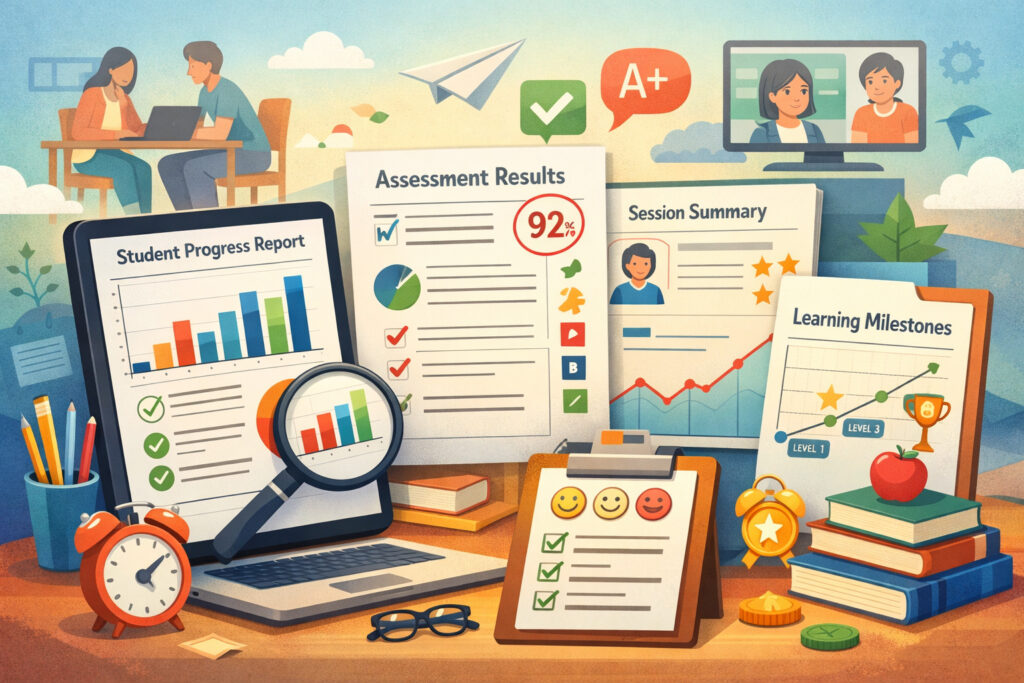
A tutor performance report is any structured output that helps you evaluate and improve tutoring sessions. Some programs imagine reports as complex dashboards, but effective tutor performance reports can be simple—if they’re consistent and tied to actions. The key is that reports must answer real operational questions, not just display numbers.
Common report types include session reports (what was taught, what changed, what’s next), progress reports (mastery and growth), engagement reports (participation and sentiment), and operational reports (attendance, cancellations, and scheduling).
Many platforms used by educators offer teacher-facing reports that track activity, skills, mastery, and assessments—showing how reporting is commonly organized around progress monitoring.
The most useful tutor performance reports share three traits:
- They are decision-ready: Each report should suggest what to do next.
- They are comparable: You can compare across tutors, students, subjects, or time.
- They are coachable: A tutor can look at the report and change something next session.
Using reports to improve tutor performance means designing reports around decisions: who needs coaching, what training to assign, which students need reteaching, and which lesson plans need adjustment. If your reports don’t lead to a next step, they’re just data decoration.
The core metrics every tutor performance report should include

Many programs track too much, too soon. The best tutor performance reports start with a small set of “core metrics” that represent outcomes, quality, engagement, and reliability. This balanced approach prevents gaming and keeps tutors focused on what matters.
Student learning outcomes: growth, mastery, and readiness signals
Outcomes answer the question: did learning move? Depending on your setting, this might mean skill mastery, quiz improvement, assignment completion, or growth on benchmark standards. Mastery-style reporting (progress toward unit or course mastery) is widely used in education reporting because it makes progress visible and helps teachers plan targeted support.
To make outcome metrics fair, segment them. Compare students by starting level, not just raw scores. A tutor working with struggling learners may show lower absolute scores but higher growth.
Tutor performance reports should reflect growth curves, mastery milestones, and “readiness” indicators (whether the student is prepared to advance).
Instructional quality: observable tutor behaviors that drive learning
Instructional quality should be measured with behaviors you can coach. Examples include:
- Use of checks for understanding (quick questions, mini-quizzes, student explanations)
- Quality of feedback (specific, timely, actionable)
- Questioning strategy (open-ended prompts that require reasoning)
Some tutoring managers use simple rubrics that score questioning quality and student explanation time because these behaviors predict deeper understanding.
These metrics work best when tutors know the rubric in advance. Tutor performance reports should never surprise tutors with hidden evaluation criteria.
Engagement and satisfaction: the early warning system
Engagement is often the first metric to drop before outcomes decline. Track attendance, participation, student confidence, and brief satisfaction ratings. Short post-session pulses (“I understood today’s topic” on a 1–5 scale) can be enough. Engagement metrics help you coach tutors on pacing, rapport, and clarity.
Operational reliability: the baseline for trust
Reliability includes punctuality, cancellations, session notes completion, and responsiveness. Even an excellent tutor harms outcomes if sessions are inconsistent. Operational metrics belong in tutor performance reports because they shape the student experience and retention.
Using reports to improve tutor performance means treating these four metric families as a single system. If outcomes drop, check engagement and reliability before blaming instruction.
Turning raw data into insights: how to interpret tutor performance reports correctly

A common failure mode is misreading reports. Data without interpretation can punish strong tutors, reward easy assignments, or create anxiety. To use tutor performance reports responsibly, you need a clear interpretation method.
Start by distinguishing signal vs. noise. One bad session is noise; a repeated pattern over several sessions is a signal. Build tutor performance reports that show trends across time, not just snapshots.
Next, separate student factors from tutor factors. A student’s attendance, home support, and baseline skill level can influence outcomes. Reports should include context (starting level, number of sessions, missed sessions) so you avoid unfair conclusions.
Then, apply “triangulation.” Don’t coach from one metric. If mastery is flat, check session notes: did the tutor reteach misconceptions? If satisfaction is low, check pacing and questioning. This approach mirrors formative assessment cycles, where educators interpret evidence and adjust instruction rather than treating scores as final verdicts.
Finally, use segmentation. Compare tutors by subject, grade band, and student starting level. Tutor performance reports become far more accurate when you compare like with like.
Building a reporting rhythm that actually improves tutor performance
Reports improve performance only when they’re used consistently. High-performing programs adopt a reporting rhythm—weekly, biweekly, and monthly loops—that turn tutor performance reports into action.
Weekly: fast feedback and course correction
Weekly tutor performance reports should be lightweight: attendance reliability, session completion, brief engagement pulses, and any red flags (missed sessions, repeated confusion on a skill). The goal is quick correction, not deep evaluation. A weekly rhythm prevents small problems from becoming chronic.
Biweekly: coaching and micro-training assignments
Every two weeks, use tutor performance reports to run coaching conversations. Pick one strength and one growth area. Assign one micro-training task (for example, improving wait time after questions) and one practice goal (for example, having the student explain steps aloud three times per session). Reports provide evidence to support the coaching plan.
Monthly: program-level insights and tutor calibration
Monthly reviews should include deeper outcome trends, rubric-based instructional scores, and cohort comparisons. This is the best time to calibrate tutors—making sure everyone understands what “good” looks like on the rubric.
Programs that monitor and evaluate tutoring quality often emphasize consistent monitoring and structured evaluation because it strengthens outcomes and professional development.
Using reports to improve tutor performance requires consistency. The rhythm matters more than the dashboard design.
Designing session reports that tutors will complete and leaders will trust
Session reports are the foundation of tutor performance reports because they capture the “why” behind the numbers. But many session reports fail because they’re too long, too vague, or too disconnected from planning.
A strong session report is short, structured, and instructional. It typically includes:
- Topic and objective (what the student was supposed to learn)
- Evidence of understanding (how you checked mastery)
- Misconceptions (what went wrong and why)
- Next steps (what to do next session)
- Student affect (confidence, frustration, motivation)
When session reports are consistent, leaders can spot patterns across tutors and students. They also help tutors reflect, which improves instructional judgment. This reflective loop aligns with formative practice: collect evidence, interpret, adjust.
To increase completion, keep session report fields mostly selectable (dropdowns for standards, misconceptions) with one short narrative box. If you want tutor performance reports to be reliable, session reports must be easy enough that tutors don’t rush or copy-paste.
Coaching tutors with data: a practical framework that avoids defensiveness
Tutor coaching is where tutor performance reports become real. The goal is not to “audit” tutors—it’s to help them improve faster. Data-driven coaching works best with a simple structure.
Step 1: Start with the student story, not the tutor score
Open coaching by reviewing student progress: “Here’s what changed.” This keeps the conversation grounded in learning, not judgment.
Step 2: Use one report insight and one example
Pick a single insight (for example, “accuracy improves when students explain steps”) and back it with one short example from session notes or a recording snippet. Avoid dumping a full dashboard.
Step 3: Co-design the next experiment
Ask the tutor to choose a small change for the next two weeks. Make it measurable. For example: “Add two open-ended questions per session.” Some tracking guides explicitly recommend scoring questioning techniques because they’re observable and coachable.
Step 4: Close the loop with the next report review
Using reports to improve tutor performance depends on closure. If you assign a goal, your next tutor performance report should show whether it happened and whether it helped.
This coaching approach keeps tutors motivated. It turns tutor performance reports into a partnership tool, not a surveillance tool.
Using reports to improve tutor performance in high-impact tutoring models
High-impact tutoring—often defined by consistent sessions, aligned materials, and small ratios—benefits heavily from reporting because the model depends on fidelity.
Research and best-practice summaries emphasize the importance of low student-to-tutor ratios and alignment to classroom materials as factors tied to effectiveness.
In high-impact models, tutor performance reports should track:
- Dosage (sessions delivered vs. planned)
- Alignment (whether tutoring matches classroom scope and sequence)
- Targeting (whether sessions focus on identified gaps)
- Mastery checks (whether students demonstrate learning before moving on)
Programs sometimes make the mistake of tracking only dosage. Dosage matters, but dosage without quality can waste time. Tutor performance reports should reveal whether tutors are using data to target the right skills and whether students are actually mastering them.
Using reports to improve tutor performance in this context also means monitoring implementation consistency across sites, schools, and tutor cohorts. Reports can show where training needs are concentrated—like a common misconception pattern that suggests the curriculum explanation needs improvement.
Data privacy, consent, and trust: making reporting safe and compliant
Tutor performance reports often include student information, and that raises privacy obligations. If you work with K–12 students or education partners, you need strong data governance. Federal student privacy resources emphasize safeguarding student information and understanding privacy obligations and rights.
At a practical level, “safe reporting” means:
- Collect only what you need (data minimization)
- Restrict access by role (tutors see their students; leaders see aggregates)
- Document what data is collected and why
- Secure storage, encryption, and retention policies
- Vendor agreements that define data use
Many compliance guides discuss key student privacy laws that affect how educational data can be collected and shared, including laws that often apply to edtech and youth data.
Trust matters as much as compliance. Tell tutors how tutor performance reports are used, how they are not used, and what support systems exist. The fastest way to ruin reporting is to use it for surprise punishment. If tutors believe reports are a trap, data quality drops and coaching becomes harder.
Common mistakes that make tutor performance reports useless
Even well-funded programs build reporting systems that don’t improve tutor performance. Here are the most common failures and how to fix them.
Mistake 1: Measuring everything and acting on nothing
A giant dashboard doesn’t help if no one knows what to do with it. Fix this by tying each report section to a decision: coach, train, reassign, reteach, or celebrate.
Mistake 2: Comparing tutors unfairly
If you rank tutors by raw student scores, you punish tutors assigned to higher-need students. Instead, use growth and segmented comparisons.
Mistake 3: Treating reports like surveillance
When tutors feel watched, they optimize for looking good rather than helping students. Make tutor performance reports a coaching tool. Share rubrics. Celebrate improvements.
Mistake 4: Ignoring the instructional “why”
Numbers without session notes lead to shallow coaching. A data webinar focused on measuring tutoring effectiveness highlights that programs should use data to understand both student learning and tutor teaching quality—not just outcomes.
Using reports to improve tutor performance means designing reports that lead to action, build trust, and capture instructional context.
The future of tutor performance reports: AI, automation, and predictive coaching
Tutor performance reporting is moving toward automation and prediction. The next wave is less about displaying what happened and more about suggesting what to do.
AI-assisted session analysis and auto-summaries
As more tutoring happens online, platforms can analyze transcripts, pacing, and question types. AI can generate draft session notes, flag moments of confusion, and highlight missed opportunities for checks for understanding. The benefit is speed and consistency—if governance is strong.
Predictive risk flags for student dropout and stagnation
Future tutor performance reports will likely include “risk of disengagement” indicators based on attendance patterns, sentiment, and stagnating mastery. These flags help leaders intervene earlier with schedule changes, different instructional strategies, or parent communication.
Personalized tutor training pathways
Instead of generic training, tutor performance reports will trigger micro-modules: a tutor who asks mostly yes/no questions gets a questioning module; a tutor with low engagement gets a rapport and pacing module.
More guidance on generative AI in schools
Because AI is expanding rapidly in education, more state-level guidance and policies are emerging, especially around AI use in K–12 settings and privacy. This will influence what data can be collected, how AI can assist reporting, and what disclosures are required.
The best future prediction is this: using reports to improve tutor performance will become more real-time, more automated, and more regulated. Programs that build trustworthy privacy practices now will adapt faster later.
FAQs
Q.1: What is the best way to start using tutor performance reports if we have no system today?
Answer: Start small and consistent. Build a weekly tutor performance report that includes attendance reliability, a short session note template, and one learning outcome indicator (mastery check or mini-assessment).
Then add one instructional quality rubric item (for example, “student explained reasoning at least twice”). After two to four weeks, you’ll have enough baseline data to coach without overwhelming tutors.
Programs focused on monitoring and evaluating tutoring quality often recommend structured monitoring because it improves development and outcomes over time.
Q.2: How often should we review tutor performance reports with tutors?
Answer: A weekly quick check plus a biweekly coaching review is a strong baseline. Weekly reviews catch operational issues early. Biweekly coaching reviews allow enough time for a tutor to try a new strategy and show progress in the next tutor performance report. Monthly program reviews help calibrate standards and training.
Q.3: How do we keep tutor performance reports from damaging morale?
Answer: Make reports transparent, coachable, and fair. Share the rubric in advance. Compare tutors within similar contexts (subject, student level). Highlight wins as often as gaps. Most importantly, connect tutor performance reports to support: training, peer mentoring, and resources—not just criticism.
Q.4: What metrics matter most: test scores, mastery, or student satisfaction?
Answer: You need a balanced set. Mastery and growth show learning movement. Engagement and satisfaction show whether students will keep showing up. Reliability shows whether the program is stable.
A balanced dashboard approach is often recommended so you don’t over-focus on one dimension. Using reports to improve tutor performance means combining metrics so you can diagnose the real cause of problems.
Q.5: Are tutor performance reports allowed to include student data?
Answer: They can, but you must follow student privacy obligations and data governance. Use role-based access, collect only necessary data, and secure storage.
Federal student privacy resources provide guidance and support for safeguarding student information. When in doubt, keep reports more aggregated for leadership and more limited for broad distribution.
Q.6: Can we use AI tools to generate tutor performance reports?
Answer: Yes, but do it carefully. AI can draft session summaries, categorize misconceptions, and flag patterns, but you need human oversight and clear policies on data use. As guidance on generative AI in schools continues to develop across states, expect tighter expectations around transparency and privacy.
Conclusion
Tutor performance reports work when they become part of a living improvement cycle: capture evidence, interpret it fairly, coach one small change, and confirm progress in the next report. The programs that succeed don’t necessarily have the fanciest dashboards—they have the clearest reporting rhythm, the most coachable metrics, and the highest trust.
Using reports to improve tutor performance requires balance. Track outcomes, but also track the instructional behaviors that create outcomes. Track engagement so you can intervene early. Track reliability so students experience stable support.
Interpret data with context so tutors feel treated fairly. And build privacy and governance into reporting from day one, because trust and compliance are foundational.